How to Run Social Media for a Small Business When You Have No Time
If you run a small business, do more social media is useless advice. You do not have spare hours. You have a business to run, and social media is competing with payroll, suppliers and whatever went wrong this morning. The useful question is not how to do more of it. It is how to stay visible on the least possible time, and where the line is past which you should stop cutting and hand it over.
Where the time actually goes
Before cutting anything, it is worth knowing which part you are cutting. People assume posting is the expensive step because it is the visible one. It is the cheapest thing in the chain.
| The step | Roughly what it takes | Can you cut it? |
|---|---|---|
| Deciding what to post | The worst of it, especially from a blank page | Not by trying harder — only with a rotation |
| Writing the caption | Ten to twenty minutes if you do not hate it | Partly, by reusing shapes that work |
| Making the image or video | Longer than everything else combined | This is the one worth attacking first |
| Adapting it per platform | Multiplies by however many platforms | Yes — cut platforms, not corners |
| Publishing | Seconds | Already solved by any scheduler |
Notice that the two most expensive rows are the first and the third. Any plan that leaves those with you has not saved you much, whatever else it automates.
Cut deliberately, not apologetically
Trying to do everything everywhere is how busy owners burn out and quit, and quitting costs more than never starting. Narrow on purpose, and be at peace with it.
- Cut platforms before you cut frequencyTwo platforms posted properly beat four posted thinly, and each one you drop removes a whole column of work rather than a row. Pick where your customers actually are, not where the reach numbers are largest.
- Cut originality before you cut qualityThe same idea can run on every platform in a different shape. What you should never do is post the identical caption everywhere, because the mismatch is obvious to anyone reading.
- Cut variety before you cut rhythmA short list of go-to post types you rotate is not boring, it is a format. Customers do not experience your feed the way you do, all at once. They see one post on a Tuesday.
- Do not cut repliesAn account that posts daily and answers nobody reads worse than one that posts weekly and talks to people. Replies are the cheapest high-value minutes in the whole activity.
Batch whatever you are keeping
For anything you still do yourself, batching is the single biggest saving available, and it is free. Dipping into posting across the week costs far more than the work does, because every re-entry is a fresh set of decisions and a fresh loss of focus.
The thirty-minute week
Pick a fixed slot, ideally Monday morning while you still have some control over the day. Work from your rotation rather than from imagination. Write all the captions first, in one pass, without stopping to find images — switching between writing and making is what destroys the hour. Then do all the visuals in a second pass. Then queue the lot.
Two passes instead of seven interruptions is usually the difference between thirty minutes and three fragmented hours that felt like a whole day.
The point where cutting stops working
There is an honest limit to how far you can trim before you have cut the thing itself. If you are down to one post a week and still missing it, the problem is no longer scope. You have run out of hours, and the only remaining moves are to delegate or to accept a quiet account.
Delegating to a person works and is expensive for daily posting, because you are buying ongoing labour plus the overhead of briefing and reviewing it. Delegating to software is the cheaper version of the same trade: it produces the posts as well as publishing them, so a bad week does not empty anything.
◆ MADE BY POSTOTTER, FOR POSTOTTER
Real posts on our own accounts. Your free week looks like this.
Same brand, three different posts. Instagram and TikTok share the render; the captions don't. Each one is written native to the platform it's on, and the hashtags are weighted the way that platform's discovery actually works. That is why Instagram gets ten and X gets two.
Here is the plain version of what PostOtter does. 1) You drop in your website URL. PostOtter reads it to learn your brand voice, what you sell, and how you talk. 2) You connect your accounts. Instagram, TikTok, and X. That is it.
#socialmediamanager#marketingautomation#smallbusinessowner#solopreneur#founderlife#brandvoice#instagramreels#tiktokmarketing#PostOtter#PostOtterAISee it on InstagramYou're juggling a line out the door, and your “scheduler” is still waiting for you to write the post. That is not help. PostOtter learns your brand voice from your website, then creates, schedules, and publishes a post every day to X, Instagram, and TikTok.
#socialmediamarketing#smallbusinessowner#solopreneur#contentmarketing#instagramreels#tiktokmarketing#marketingautomation#PostOtterSee it on TikTok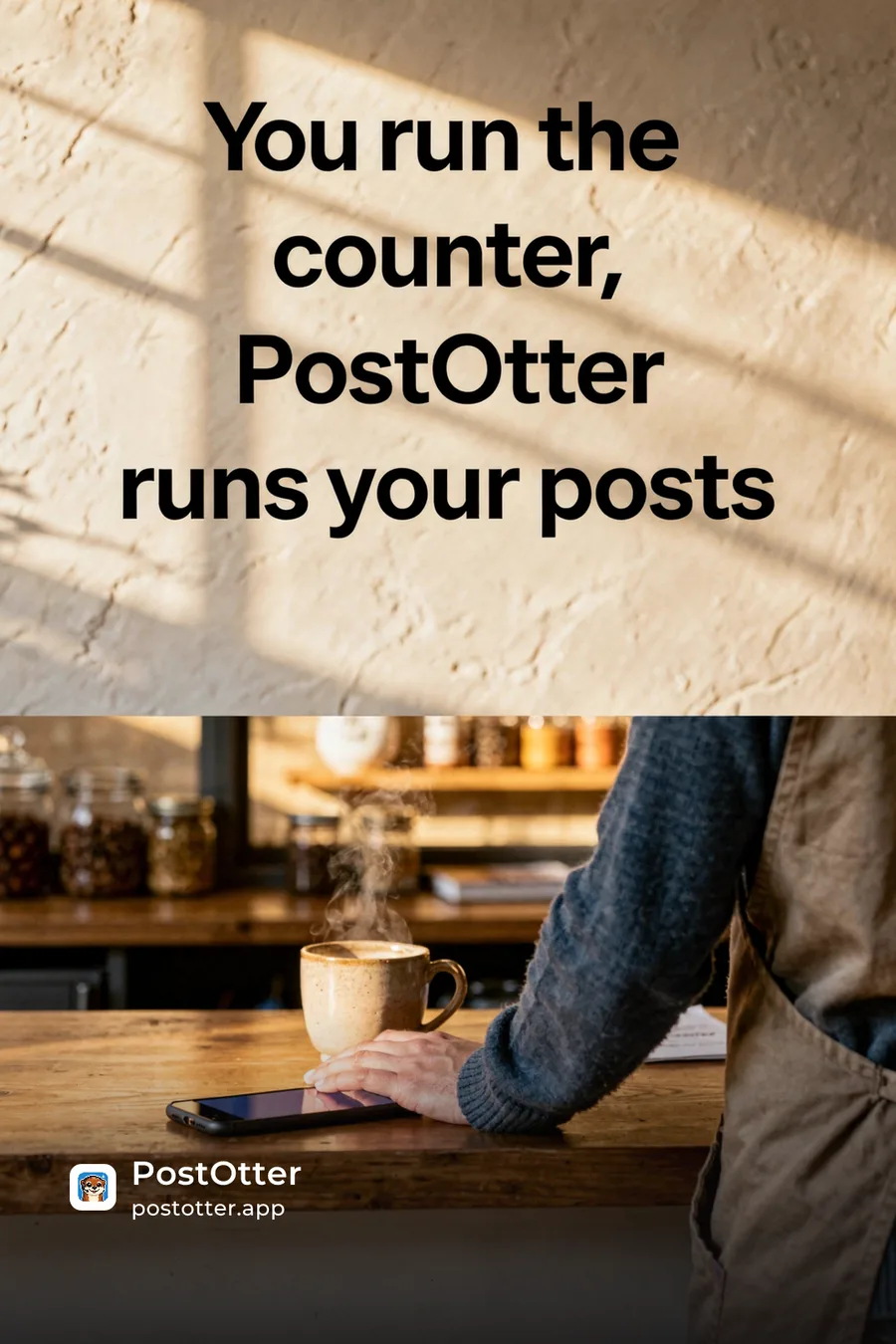
You open a scheduler and it just stares back, waiting for a caption you don't have. So you post nothing. Again. PostOtter isn't a scheduler—it creates, schedules, and publishes daily to X/IG/TikTok (images + real Reels/TikTok video). Try it today.
#smallbusinessowner#PostOtterSee it on Xwe didn't lift a finger: no captions written, no hashtags picked, no content made, no times set, nothing published by hand
but every one of them was ours to change first: rewrite the caption, swap the hashtags, upload your own photo or video, move it to another day. and so is every post you get.
What to keep for yourself, even then
- Anything that needs to know about today — a closure, a delay, a sold-out item, changed hours.
- Replying to comments and questions, which takes minutes and is worth more than another post.
- The occasional real moment: a customer doing something lovely, a local event, something that actually happened in the shop.
- The final say. Automation should mean you stop making posts, not that you stop having an opinion about them.
Common time-wasters worth dropping
- Rewriting a caption five times. The fourth version is not better, it is just later.
- Chasing every new platform. A new account is a new column of work and it starts at zero.
- Reading your analytics daily. Nothing meaningful changes inside a week, and the checking is not free.
- Designing custom graphics for posts nobody will remember on Thursday.
- Waiting for the perfect photo before posting anything at all.
◆ QUICK ANSWERS
Frequently asked
How much time does social media take for a small business?
By hand, budget the better part of an hour per post once you count deciding what to say and making something to look at. Publishing itself takes seconds. That gap is why scheduling tools save less time than people expect, and why the creation step is the one worth attacking.
What is the minimum I can do and still get results?
One platform where your customers actually are, a short rotation of post types so you never start from a blank page, a rhythm you can hold indefinitely, and replies to anyone who comments. That is a working presence. Everything above it is upside.
Is it better to batch social media content?
Yes, and it is the biggest free saving available. Write all the captions in one pass, then do all the visuals in a second pass. Switching between writing and making is what turns thirty minutes into a fragmented afternoon.
Should I post less often if I have no time?
Reduce platforms before you reduce frequency. Dropping a platform removes an entire column of work, while dropping frequency breaks the rhythm that makes any of it work. And whatever cadence you land on, pick one you would still hit in your worst week.
When should I stop doing social media myself?
When you are already at the minimum and still missing it. At that point the problem is not scope, it is hours, and the only options left are to delegate to a person, delegate to software, or accept a quiet account.
◆ KEEP READING
◆ TRY POSTOTTER
Hand your social media to an AI that never forgets to post.
A post every day across Instagram, TikTok, and X. Written, made, and posted in your brand voice. First week free, no card.
Start free →